
She wants to break the silence surrounding birth injuries
Although birth injuries to the mother can cause lifelong problems, such as incontinence and pain, little is said about them. LTH doctoral student Semra Sahin-Haglund wants to change that. In her licentiate thesis in Rehabilitation Engineering, she tackles the subject with humour, satirical drawings and metaphors – she wants women's experiences to be given more attention and become easier to talk about. The goal is to increase knowledge and contribute to better pelvic floor care.
– Published 23 January 2026
Every year, 80 - 90,000 vaginal deliveries take place in Sweden. Of the women who give birth, up to 3,200 suffer serious pelvic floor injuries, and even more suffer minor injuries. Many recover, but for others it can lead to severe, lifelong problems such as incontinence and pain. Through observations and interviews, Semra Sahin-Haglund has investigated women's experiences of suffering a serious pelvic floor injury and how they are treated in aftercare.
The interviews revealed an unexpected focus
Semra Sahin-Haglund says that during her interviews with the affected women, she realised that the focus of her research is a minor issue in the women’s context.
“I thought they would talk more about how their pelvic floor injury had affected their lives, but they focused more on the birth itself and caring for their baby. They saw their injuries more as a side issue, something unexpected that didn't really have a place in their baby bubble.”
Bubble metaphor
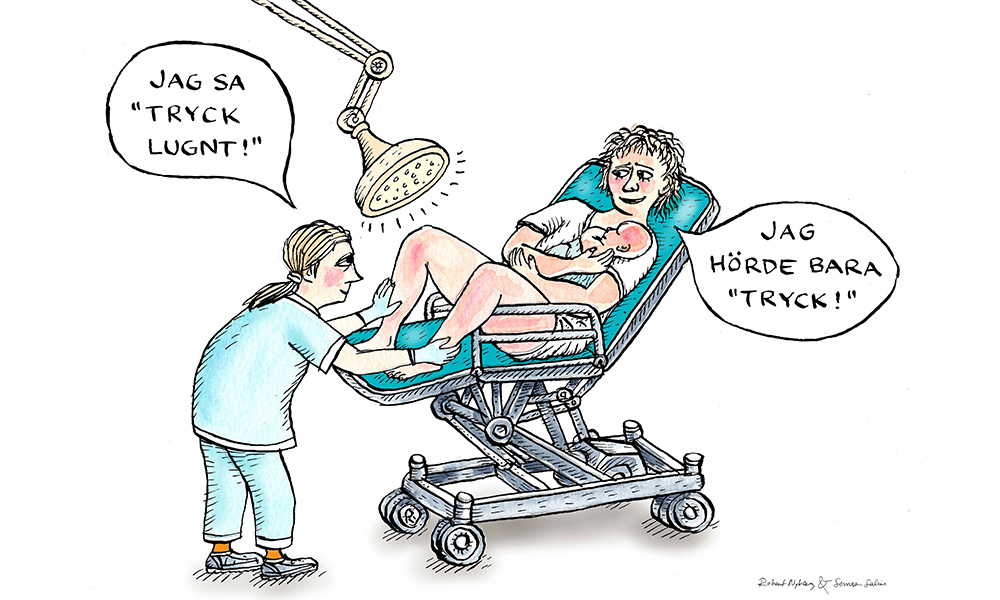
During the interviews, the ‘bubble’ is a recurring metaphor for how women create distance from their surroundings and enter their own world – pregnancy bubble, childbirth bubble, baby bubble, says Semra Sahin-Haglund. She believes that the bubble can make things difficult for those outside it; for example, it can affect the dialogue between healthcare staff and women during childbirth.
“The bubble metaphor is something I intend to work on further to understand how it arises and functions. I see an opportunity here to contribute knowledge that will hopefully improve communication between staff and women.”
From sketches to comic strips
Semra Sahin-Haglund sketches the situation during her observations of meetings between healthcare staff and the women affected. She explains that the sketches are used as an aid to remember specific situations, but they have also developed into something more.
“It was at an exhibition of cartoonist Robert Nyberg’s drawings that the idea of creating visual satire from my sketches was born. Using humour can make it easier to talk about difficult topics, such as incontinence.
Semra Sahin-Haglund's licentiate thesis became the starting point for the research she is now pursuing in her doctoral studies – with the ambition of highlighting women's experiences and contributing to greater knowledge about life with pelvic floor disorders.

Semra Sahin-Haglund
In her research, Semra Sahin-Haglund has used a design perspective to create an understanding of the complex situation that pelvic floor injuries can give rise to, and universal design as a critical tool for studying and discussing women's experiences. She has made observations and conducted in-depth interviews with ten affected women and analysed these using qualitative methods.